
Over on reddit, CCP Quant recently posted a very interesting graphical representation of 2012 Production and Destruction values. This is a slightly more detailed version (includes some system names) of Dr Eyjo's 2013 Fanfest presentation slide (see below).
In this slide, security status decreases radially from the center and the circle area is scaled versus the value (ISK) of the property reported.
Now, let's be completely clear on several points before I go any further:
- I am in no way questioning the validity of the raw data.
- The data presented is by total system VALUE only.
- I'm not an economist.
What I am concerned about is the validity of some of the interpretations that a number of commentators have already been very quick to make, see for example, Greedy Golbin's "I told you!", Poetic's "April In Review" and on the EVE O forums.
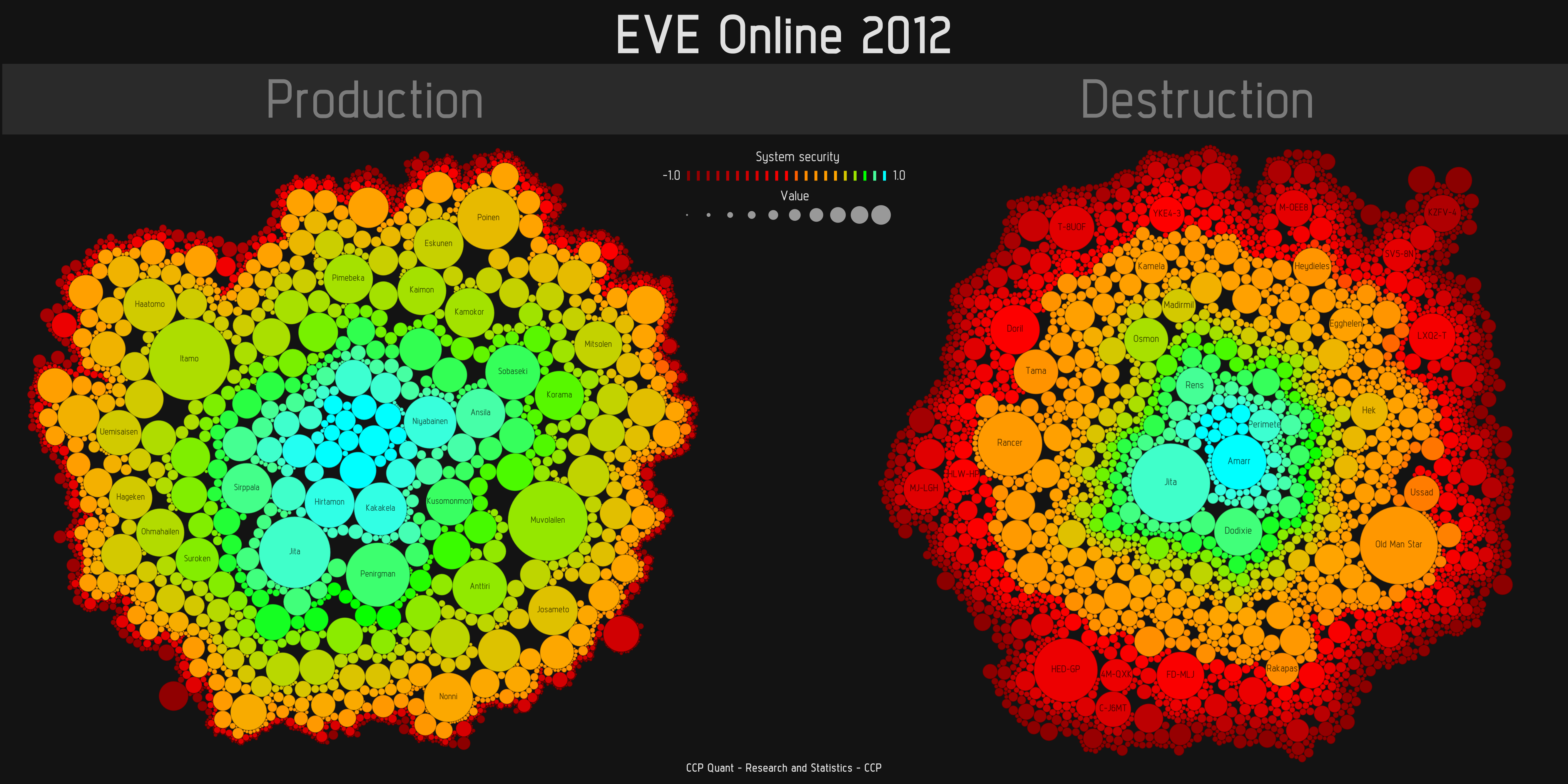
Let's take a closer look at the production side. I would imagine that most readers are familiar with GDP and this is what appears to have been presented in the left hand image. My first concern is that it is unclear if the import and export values of goods has been included. This has particular relevance to T2 precursor production items and converting minerals into goods for reprocessing elsewhere (mineral compression for ease of transport). Essentially, what I'm wondering is if some of the value has been duplicated, or incorrectly represented, by the transferral of goods between systems, as part of the production cycle?
My second area of concern is that the production values do not appear to have been normalized on a per capita basis. The difference this point makes is immediately apparent when one looks at in real life national economics of countries by GDP (nominal) versus GDP per capita. So, we could have the situation of a manufacturer in a quiet low or null sec system producing high value goods, but the total value is dwarfed when compared to a system with a very high population in high sec system producing T1 ammo and modules.
Let's move onto the destruction figure in the ammended presentation slide above. Remember, this is a total value per system representation. it tells us nothing about the level of pew pew activity.
In a recent blog post, I discussed risk in known space and used data available from DOTLAN (see linked post for details) to compare a suggested risk metric for the three security regions, in relation to recent expansions. Using the same data set, I summed the 2012 ship kills per month for high, low and null sec to give an overall 2012 figure for each. Here's the pie chart representing those summations;

Shocking isn't it? More explosions occur in high sec than in either low or null sec space. It should be noted that since the Retribution expansion, the number of ship kills in low sec has risen significantly (approximately, by a factor of 2).
Why then, you might ask, is there such a disparity between the size of areas in the destruction value of CCP Quant's chart and the above number of ships destroyed in the pie chart? The answer. of course, is that we are measuring two different, though related, quantities - one is value in ISK, the other is an interger number of destruction instances.
At this point I should qualify the above pie chart with a word of caution. Just like CCP's chart, my pie chart does not take into consideration population demographics. So whilst I can say that more ships in low sec and high sec are destroyed than in null sec, I cannot drill down further and come to a more valuable conclusion on how many ships per sec resident character are destroyed.
The purpose of this blog post has not been to fuel the "this sec is better than that sec" arguement. I'm humbly suggestiong that we do not take manipulated data at face value, without knowing or questioning, what we are being presented with, no matter the source.
I'm actually quite interested to see how the Odyssey expansion impacts pew pew across all security sectors. Overall, might we end up with fewer, but more expensive explosions or will the current level of low cost pew pew be maintained? I hope it is both!

No comments:
Post a Comment