One of the unsung attractions found in playing EVE Online is the vast array of external game related activity that that goes on. This can vary from simply tweeting and following the #tweetfleet Twitter feed, right through to participating in player created gatherings. In between, we find a cornucopia of blogs, videos and propaganda art.
As an E-Uni student I recorded and posted a couple of my EVE game play videos (don't laugh, I know I'm bad at EVE and even worse at FRAPS recording & video editing). Creating each video was a real learning experience. In fact, I probably started blogging and throwing in the occasional tweet, for much the same reasons - to learn, to challenge and entertain - primarily for myself, but if a wider audience also benefited along the same lines too, then so much the better.
I have been especially impressed with some of the propaganda posters created for various alliances, corporations and in game events. I yearn to be able to produce something of the same quality and impact as those examples. As an in real life scientist, I find my artistic talents somewhat dulled down, but my enthusiasm knows no bounds. As a proud member of NYAN Cat Pirates corporation, I was keen to attempt to produce a NYAN propaganda (NYAN-AGANDA, get it?) poster. I discovered a super sci fi pulp magazine cover generator, via the RvB forums, in the shape of Pulp-O-Mizer. I created a very straight forward cover and saved it to my desktop. Using the free GIMP GNU image manipulation package, I imported my poster and added a couple more layers. Here's the result:
I know this effort won't win any prizes, but consider it a prototype and the green shoots of better things to come.
Kinisiology
Kinisiology, also known as capsuleer kinetics, is the scientific study of various player interactions in EVE Online.
Wednesday, 8 May 2013
Wednesday, 1 May 2013
Statistically Speaking 2012
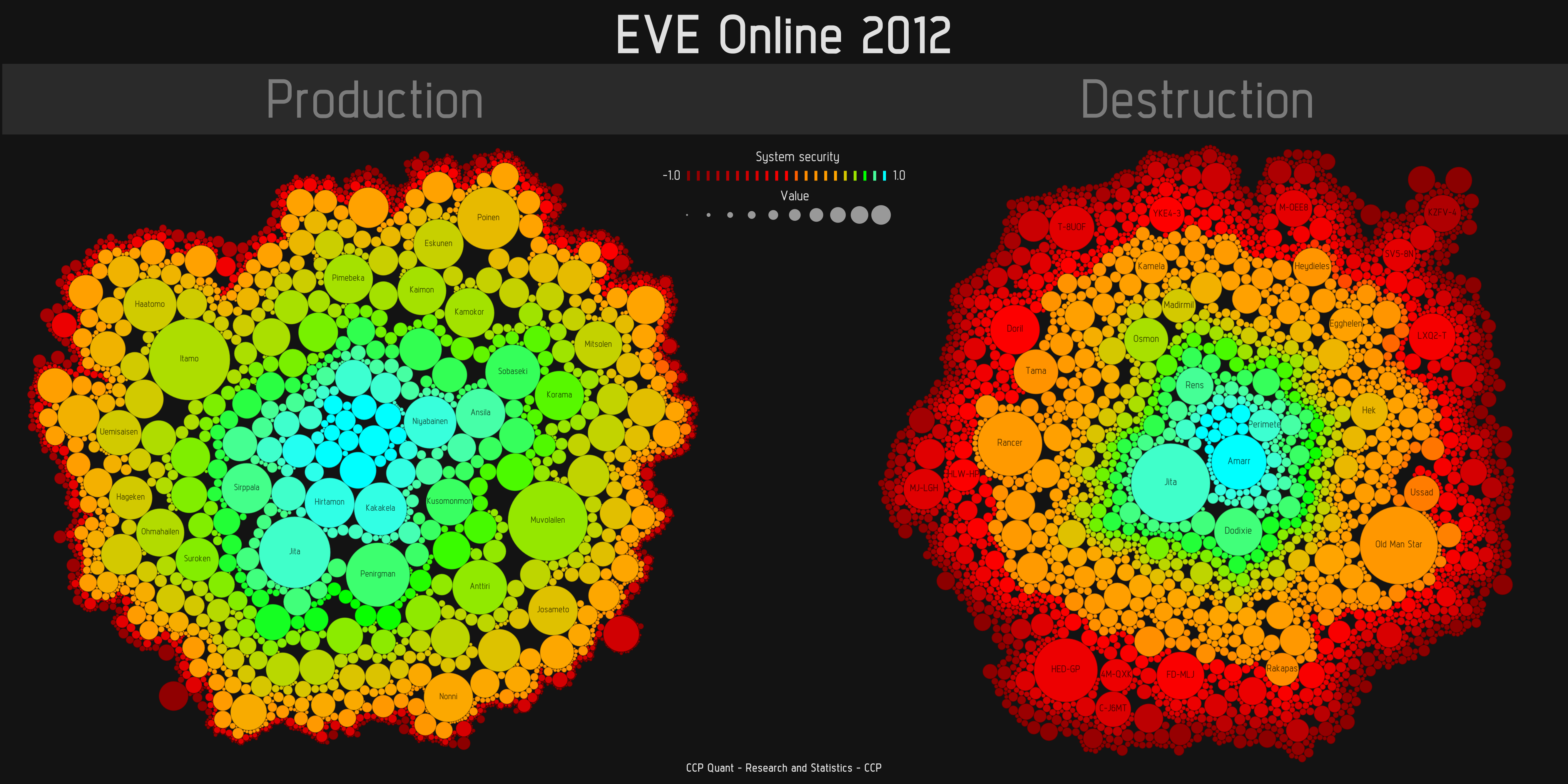
Over on reddit, CCP Quant recently posted a very interesting graphical representation of 2012 Production and Destruction values. This is a slightly more detailed version (includes some system names) of Dr Eyjo's 2013 Fanfest presentation slide (see below).
In this slide, security status decreases radially from the center and the circle area is scaled versus the value (ISK) of the property reported.
Now, let's be completely clear on several points before I go any further:
- I am in no way questioning the validity of the raw data.
- The data presented is by total system VALUE only.
- I'm not an economist.
What I am concerned about is the validity of some of the interpretations that a number of commentators have already been very quick to make, see for example, Greedy Golbin's "I told you!", Poetic's "April In Review" and on the EVE O forums.
Let's take a closer look at the production side. I would imagine that most readers are familiar with GDP and this is what appears to have been presented in the left hand image. My first concern is that it is unclear if the import and export values of goods has been included. This has particular relevance to T2 precursor production items and converting minerals into goods for reprocessing elsewhere (mineral compression for ease of transport). Essentially, what I'm wondering is if some of the value has been duplicated, or incorrectly represented, by the transferral of goods between systems, as part of the production cycle?
My second area of concern is that the production values do not appear to have been normalized on a per capita basis. The difference this point makes is immediately apparent when one looks at in real life national economics of countries by GDP (nominal) versus GDP per capita. So, we could have the situation of a manufacturer in a quiet low or null sec system producing high value goods, but the total value is dwarfed when compared to a system with a very high population in high sec system producing T1 ammo and modules.
Let's move onto the destruction figure in the ammended presentation slide above. Remember, this is a total value per system representation. it tells us nothing about the level of pew pew activity.
In a recent blog post, I discussed risk in known space and used data available from DOTLAN (see linked post for details) to compare a suggested risk metric for the three security regions, in relation to recent expansions. Using the same data set, I summed the 2012 ship kills per month for high, low and null sec to give an overall 2012 figure for each. Here's the pie chart representing those summations;
Shocking isn't it? More explosions occur in high sec than in either low or null sec space. It should be noted that since the Retribution expansion, the number of ship kills in low sec has risen significantly (approximately, by a factor of 2).
Why then, you might ask, is there such a disparity between the size of areas in the destruction value of CCP Quant's chart and the above number of ships destroyed in the pie chart? The answer. of course, is that we are measuring two different, though related, quantities - one is value in ISK, the other is an interger number of destruction instances.
At this point I should qualify the above pie chart with a word of caution. Just like CCP's chart, my pie chart does not take into consideration population demographics. So whilst I can say that more ships in low sec and high sec are destroyed than in null sec, I cannot drill down further and come to a more valuable conclusion on how many ships per sec resident character are destroyed.
The purpose of this blog post has not been to fuel the "this sec is better than that sec" arguement. I'm humbly suggestiong that we do not take manipulated data at face value, without knowing or questioning, what we are being presented with, no matter the source.
I'm actually quite interested to see how the Odyssey expansion impacts pew pew across all security sectors. Overall, might we end up with fewer, but more expensive explosions or will the current level of low cost pew pew be maintained? I hope it is both!
Sunday, 28 April 2013
Incarna, Itchy Feet & Indecision
To give you some perspective on my playstyle and abilities, I'm from the Space Invaders and table top RPG generation. Let's just say I'm not the most natural of gamers and mention the fact that my 12 year old son has to help me out when I play FPS games on the PS3.
I loved playing all big space themed PC games such as Elite, Homeworld, Epic and Wing Commander so one might well wonder why I'd not taken the obvious progression to EVE Online. Looking back, I'm struggling to remember why I'd never taken the plunge into Eve Online before as well. Maybe it was fear of the subscription payment model at a time in my real life (marriage, young family, new house) when each penny of my salary was allocated to household expenditure.Whatever the reason, my journey into the serious business of internet space ships didn't begin until July 2011.
the SoE Arc, applying to E-UNI seemed to be the natural thing to do. I joined a couple of months before the NoWSOP event, took part in helping defend Chribba's Cottage and fought in the legendary "Battle for Aldrat" against RvB in early 2012, whilst attending the many excellent classes that the E-UNI teaching staff provide.
I had considered null sec, but the coalition type hegemony was an unattractive proposition. Besides, the inverted snobbery exhibited by the likes of Goons and TEST was always going to ruffle my fur. Looking back, I guess I assumed all null sec alliances were of a similar nature. I maybe a noob, but I sure as hell didn't want to be a scrub helping to inflate some null overlord's massive ego or go on about how awesome the last episode of My Little Pony was. Besides, I didn't want to be part of the mega blob to roll over easy sovereignty targets or participate in the "l33t PvP" sport of ganking hi sec miners in the quest for tears. Not saying any of that stuff is wrong, it just doesn't float my space ship.
I think my attitude to null began to change after reading stories, from various sources, about less well publicised null sec corporations and alliances, particularly those that inhabited NPC null.

Towards the end of 2012, E-UNI had a number of players from 401K alliance provide a guest lecture as part of their recruitment drive. I was very impressed and really liked what I heard. At the same time, I was busily cross training in weapons and ships as well as discovering a liking for the logistics role. During this training time, I avidly followed 401K activity through eve kill and DOTLAN web sites and really liked what I was seeing. A decision was forming in my mind, but which corporation to join?I've now been a member of NYAN for a few weeks and I can't praise my fellow corp & alliance mates high enough. They've all proven to be extremely helpful in settling me in, our small gang roams are a blast - it doesn't matter if it is a whelp or a win - I've had an awesome time and being able to participate in alliance level ops, jump bridging all over the place, has been superb bonus.
One thing I have recently learnt is that my current character skills aren't quite up to scratch (damn you AWU V!) but this can be addressed relatively painlessly and will hopefully make me into a better pilot for my corporation and alliance.
CSM8 Election Turnout
Let's compare last year's CSM7 election voting pattern with that of CSM8. Please note that the graph displayed below shows a couple of outliers as a result of the different binning CCP have used when releasing the figures for each year.
My personal opinion is that many players were turned off by the more involved STV voting system. Not the system itself, but the actual effort involved in casting ones' votes. I'm so invested in the game that I voted just as soon as I possibly could. With 2 accounts and a hard copy of who I was going to vote for, it took me all of five minutes to make 14 selections on each. The process was relatively painless but certainly took longer than last year's election.
For next year, I'd like to see CCP develop tools that would make the voting process effortless, particularly for players with multiple accounts. What form those tools might take, I will leave in CCP's capable hands.
Subscribe to:
Comments (Atom)